How to Identify Greenwashing in Fashion Marketing
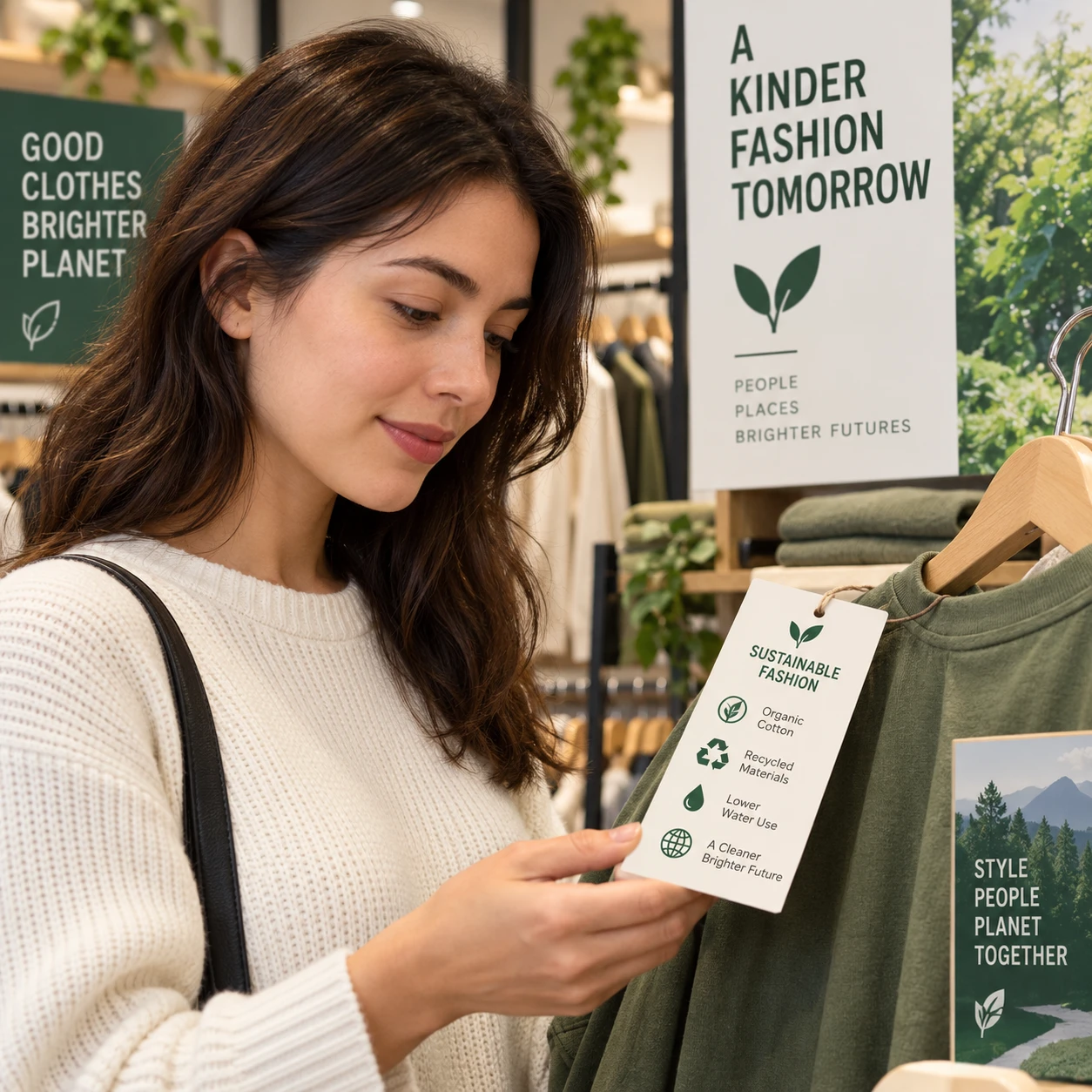
Green leaves on a clothing tag, a “conscious” collection name, or a promise of responsible production can make a garment seem like a better choice. But these signals do not, by themselves, show how a product was made or what impact it has. Greenwashing in fashion marketing happens when environmental claims create a more sustainable impression than the available evidence supports.
You do not need to audit an entire supply chain to shop more thoughtfully. Start by checking what a claim means, whether the brand provides evidence, and whether the message applies to the whole product or only one feature. That simple process helps separate useful information from marketing language.
What greenwashing looks like in fashion
Greenwashing in fashion is the use of environmental claims or imagery that misleads shoppers about a garment’s or brand’s environmental performance. It can appear in advertising, product descriptions, collection names, packaging, and sustainability pages.
Some claims are plainly broad, such as calling a product “planet friendly” without explaining why. Others may be technically true but leave out important context. A shirt made with recycled polyester, for example, may highlight that material while saying little about its other fibres, dyeing, manufacturing, or expected lifespan.
Greenwashing does not mean every sustainability statement is false. A brand may make a genuine improvement, such as using certified organic cotton in a specific product. The question is whether its wording accurately describes the scope of that improvement. Watch for a small initiative being presented as proof that an entire business is sustainable, especially when the brand sells large volumes of fast fashion.
Look at the overall impression, not just the words. Green colours, nature photography, and leaf symbols can suggest environmental benefits even when the accompanying claim is vague. Treat imagery as advertising, then look for specific information that can be checked.
Watch for vague or unsubstantiated claims
Broad terms such as “eco-friendly,” “green,” and “conscious” are not reliable evidence on their own. A credible environmental claim should explain what it refers to and point to information that supports it.
Ask what the brand means by the phrase. Does “responsibly made” refer to the fibre, factory energy, working conditions, chemical management, packaging, or something else? Environmental claims should identify the product or business activity covered, the comparison being made, and the basis for the claim.
Be especially cautious when a claim lacks a definition, date, or measurable detail. “Less water” means little without a comparison: less than which product, made where, and measured over what stage of production? A claim about a “low-impact” fabric also needs a stated basis, since impacts can vary with farming practices, processing, energy sources, and garment care.
- Vague language: “Better for the planet” without explaining the benefit.
- Unclear comparisons: “Uses less water” without naming a baseline or method.
- Unverifiable promises: A future target with no deadline, interim milestones, or progress updates.
- Selective emphasis: A small sustainable capsule used to imply that the whole range meets the same standard.
A useful rule: the more impressive or absolute the claim sounds, the more clearly the brand should explain and substantiate it.
Look beyond a single sustainable feature
A single sustainable feature cannot establish that a garment is sustainable overall. Consider the full product, from fibre and manufacturing through use, durability, and end of life, while recognizing that brands may not disclose every detail.
Materials are a sensible place to start, but they are only one part of the picture. Check the fibre composition on the product page or care label. If a brand promotes recycled materials, find out what percentage of the garment is recycled and whether the claim applies to the main fabric, a lining, or a small trim. Recycled polyester can reduce reliance on virgin fossil-based material, but it remains a synthetic fibre and may shed microfibres during washing.
For organic fibres, look for the named standard and what it covers. “Organic cotton” does not automatically tell you how the fibre was processed, dyed, or sewn, nor does it guarantee a long-lasting garment. Fit, construction, repairability, and whether you will wear a piece often also affect its practical value.
Then consider the supply chain. Does the brand name the countries where materials and garments are made? Does it explain how it monitors suppliers? A product can use a preferred fibre while its production and business model still raise environmental concerns. This is particularly relevant to fast fashion, where frequent new releases and short use periods can undermine the benefit of an improved material.
Think in layers: material, making, use, and business model. No single layer gives the full answer, but together they help you judge whether the marketing reflects a broader effort or a limited feature.
Check labels and certifications carefully
Sustainability certifications can provide useful, independently checked information, but each one has a defined scope and is not a guarantee that a whole brand is sustainable. Verify the standard, the certificate holder, and the product or process it covers.
Start with the exact name of the certification, not a logo that merely looks official. Search the certifier’s own website for a description of its requirements and, where available, a public database or certificate number. Check whether the certification applies to the finished product, a particular fibre, a facility, or a chain-of-custody process. These distinctions matter: a certified material does not necessarily mean every stage of garment production is covered.
Third-party verification can strengthen a claim because an outside organization assesses it against stated criteria. Still, standards differ in their purpose and rigor. Some focus on fibre content or chemical restrictions; others address manufacturing processes or traceability. Read the scope rather than assuming every label measures the same things.
Be wary of a brand-created badge or phrase that resembles a certification but links only to the company’s own explanation. That does not automatically make the claim false, but it is not independent verification. If a label is difficult to verify, ask the brand for the standard name, the certifying organization, and the certificate’s scope.
Assess the evidence behind brand promises
Credible brand promises are specific, measurable, time-bound, and supported by accessible evidence. Look for current progress as well as goals, and check whether the information covers the brand’s actual products and operations.
A useful sustainability report should explain what the company measured, the boundaries of that measurement, and how it calculated results. For example, a carbon-neutral claim should clarify which emissions are included, the reporting period, how reductions were made, and what role carbon offsets play. “Carbon neutral” can describe a limited activity or accounting boundary; it does not automatically mean a company has eliminated emissions across its supply chain.
Look for named suppliers or production locations, material percentages, dates, and year-on-year progress. A target to “use more recycled materials” is difficult to assess without a starting point, a deadline, and a clear definition of what counts. Likewise, a brand’s statement about supply-chain transparency is stronger when it provides concrete supplier information or explains how traceability is checked.
Check whether the evidence is independently reviewed, and whether the report describes setbacks as well as achievements. A report that lists targets but offers no progress data gives you less to evaluate. Missing information does not prove greenwashing; it does mean the claim remains unverified from what the brand has shared.
Questions to ask before you buy
Before buying, ask what the environmental claim covers, what evidence supports it, and whether it describes the garment or only one part of the brand. These questions help you assess a claim without needing specialist knowledge.
- What exactly is being called sustainable: the garment, one material, packaging, or the company?
- Can I find a percentage, comparison, date, or method behind the environmental claim?
- Does the brand identify the certification and explain its scope?
- Where was the garment made, and does the company share any supply-chain information?
- If it uses recycled materials or organic fibres, how much of the product do they represent?
- For a carbon-neutral claim, which emissions are included, and are reductions distinguished from offsets?
- Is the garment likely to suit my needs and last through repeated wear and care?
You will not always find complete answers. Use a practical three-step check: define the claim, find the evidence, judge the scope. If evidence is limited, treat the claim as unconfirmed rather than automatically true or false. You can also choose a well-made garment you expect to wear often, or consider repair and secondhand options when they suit your needs.
FAQ
Is “eco-friendly” a reliable label on clothing?
“Eco-friendly” is too broad to establish a garment’s environmental performance by itself. Look for a specific explanation of the claimed benefit, the product or process it covers, and supporting evidence. Without those details, treat it as marketing language rather than proof.
How can I check whether a sustainability certification is legitimate?
Find the certifier’s official website and check the standard’s requirements, certificate number, holder, and scope. Confirm whether it covers the garment, a particular material, or only one production stage. A recognizable logo alone is not enough to verify the claim.
Does using recycled material mean a garment is sustainable?
No. Recycled material can be a meaningful improvement in one area, but it does not establish the garment’s full impact. Check the recycled content percentage, other fibres, production information, durability, and how the product fits into the brand’s wider practices.
What should I look for in a fashion brand’s sustainability report?
Look for clear measurement boundaries, dated and measurable targets, progress against those targets, material and emissions data, and details about suppliers or production locations. Stronger reports explain methods and limitations and identify independent verification where it exists.